When the lights go out, darkness changes fast.
Rooms feel smaller.
Sounds feel closer.
Mistakes multiply.
A bad flashlight doesn’t just leave you blind —
it burns time, drains batteries, and fails when stress is highest.
Here’s how to choose a real survival flashlight
(in under a 60-second read).
What It Does
• Restores visibility immediately
• Keeps movement controlled and deliberate
• Preserves night vision when used correctly
• Signals for help when sound won’t travel
• Works in outages, storms, wilderness, and emergencies
Light = control.
The Problem With “Brightest Is Best”
Most people shop for lumens.
That’s a mistake.
High brightness without control:
• kills night vision
• drains batteries fast
• blinds you indoors
• overheats cheap lights
Survival light is about usable light, not max output.
What Actually Matters (Field Criteria)
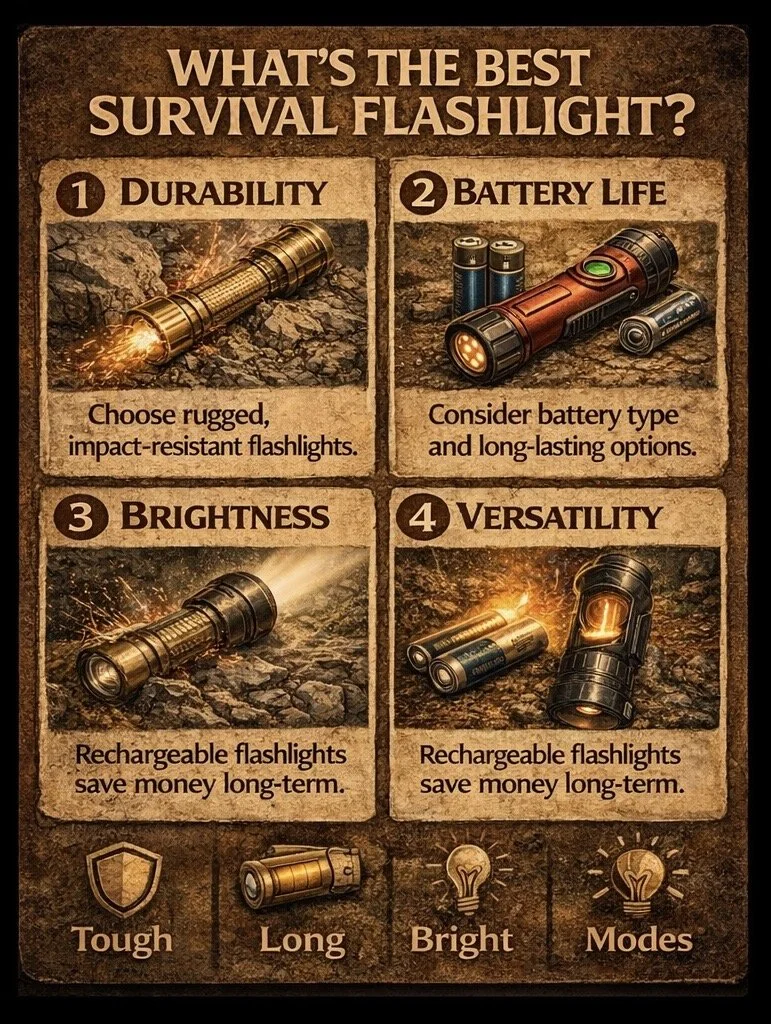
1. Beam Control
You need adjustable output.
Low mode = tasks, maps, inside shelters
High mode = distance, threats, signaling
One level lights fail fast.
2. Reliability Over Features
No touchscreens.
No gimmicks.
Fewer modes = fewer failures.
If it needs a manual, it’s wrong.
3. Battery Logic
Replaceable or rechargeable — but predictable.
You should know:
• how long it lasts
• how it dies
• how to bring it back
Surprises kill confidence.
4. Durability
Drops happen.
Water happens.
Cold happens.
Plastic flexes.
Metal survives.
How Survivalists Actually Use Light
• Low power for movement and tasks
• Shielded beam to preserve night vision
• Short bursts — not constant burn
• Light as signal, not spotlight
You don’t flood the dark.
You manage it.
Tips
• Headlamps are tools — flashlights are control
• Always test in the dark, not the store
• Carry light on-body, not in a bag
• Two lights beat one perfect light
Bottom Line
The best survival flashlight isn’t the brightest.
It’s the one that:
• turns on every time
• adapts to the situation
• doesn’t fail under stress
Darkness doesn’t panic people.
Uncertainty does.
Light removes uncertainty.

Frequently Asked Questions:
-
Durability, battery life, and simple controls.
-
They last longer and use less power.
-
Not always—runtime matters more.
-
Yes, moisture resistance adds reliability.
-
Common batteries are easier to replace.